Goodwyfe’s Corner

Welcome to my corner

Allow me to introduce myself- My name is Gillian and I am Regimental Goodewyfe to the King’s Lifeguard of Foote.

My role, off the battlefield, is to monitor the standard of dress within the regiment and to advise members of breaches of dress regulations and offer guidance with regard to improvement in kit standards.

The clothing we wear in our 17th century roles( often referred to as ‘kit’) is not a costume as one might put on for a play or party; it is replica clothing of the period and as such, attention is paid to detail such as style, fabrics and trims being appropriate to the role played.

I do not profess to be the fount of all knowledge, but I will answer any kit-related queries if I can, or direct the questioner to another source of information.

I am always happy to accompany members to trader’s row at a muster to help them choose items of kit and therefore avoid buying something which is not acceptable for wearing in public view as a member of the Sealed Knot.

If anyone wishes to make their own clothes I can also advise on suitable patterns and fabrics, trims and buttons etc.

There are very few absolute ‘rights’ –we were not there to be eyewitnesses; there is no photographic evidence – but there are many ‘wrongs’! Ongoing research is always introducing new ideas and I’m happy to hear them, – but commit a basic gaffe, such as wearing a watch, and you will find me tapping on your shoulder!

On the march to the battlefield and on the field itself, my role is to ‘marshall’ the non-combatants and civilians who form the Baggage Trayne*. We do not march in rank and file like the combatant troops, so mostly my role is that of a shepherdess, keeping everyone within the column and ensuring none get left behind!

*What is a ‘Baggage Trayne’?

During the English Civil War both Armies were followed by Baggage Traynes comprised of carts and wagons pulled by horses, oxen or men. These carried the provisions required for the campaign, siege or march as well as essential equipment, ammunition, gunpowder, tentage, water barrels etc. In effect they were a mobile Quartermaster’s Store. The Trayne might also include carriages owned by some of the more affluent officers plus their servants and worldly goods. These aristocratic officers hated to be parted from their home comforts and sometimes took along beds, clothes chests and table silver when on campaign.

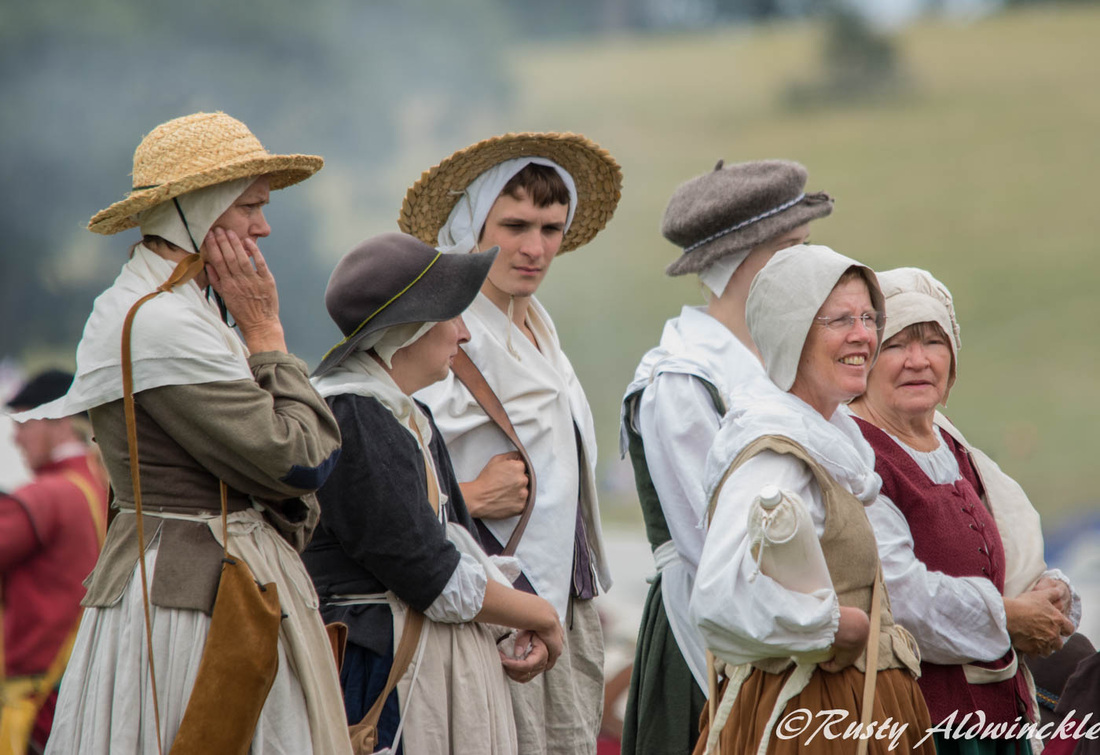
Alongside the Baggage Trayne marched the non-combatant civilians – such as barber-surgeons, armourers, farriers, bakers- and the wives and families of the common soldiers.

Once battle had commenced, these folk would either be encamped, or at least formed up a mile or two back down the road but clearly, we cannot replicate this in re-enactment. We do, however, like to give the public a vignette of civilian participation under battle conditions, whilst at the same time fulfilling a vital health and safety role for the well-being of the combatant troops.

All members of the Regiment are encouraged to march (in correct replica clothing) with the Baggage Trayne, from the ‘plastic’ campsite along the route to the battle. In marching order they will be protectively positioned behind the drummers and in front of the last pikeblock. Upon reaching the entrance to the battlefield area, the Goodewyfe will ask all civilians and any children under 16 to leave the column and the non-combatant water carriers will fall back to the rear of the column. This positioning is historically correct and also makes it easier for the officers to manoeuvre the troops into position.

Once on the battlefield, the non-combatants are under the command of the Regimental Goodewyfe or her appointed deputy. She in turn, is under the command of the Regimental Commander.

The non-combatants in the Baggage Trayne are of the poorest order and their dress and demeanour should reflect their station: due deference is given to all officers and persons of obvious rank. Their role, in re-enactment, is to take care of the regiment’s fighting troops. They may be called in to water the ‘men’ – battles are hot, dehydrating experiences – they may also tie laces, mend equipment, administer minor first-aid and generally keep an eye out for any health and safety issues. They also provide a useful set of rear-guard eyes for the officers, warning of impending attack by cavalry or encroachment by our own artillery.

The fighting troops of the King’s ‘Guard are most appreciative of the support they are given by the ‘waterladies’ of the baggage and the pike block regularly give them a respectful chorus of Huzzahs after the battle. No-one is under any illusion that being a non-combatant in the KG is a soft option!

Why not come along and give it a try?

Yours, in the cause of being the best,

Gillian Thomson, Lindsey’s Coy.

Regimental Goodewyfe to the King’s Lifeguard of Foote


Leave a Reply

Your email address will not be published. Required fields are marked *


+ six = 7

You may use these HTML tags and attributes: <a href="" title=""> <abbr title=""> <acronym title=""> <b> <blockquote cite=""> <cite> <code> <del datetime=""> <em> <i> <q cite=""> <strike> <strong>

Please leave these two fields as-is:

Protected by Invisible Defender. Showed 403 to 49,508 bad guys.

Protected by WP Anti Spam